
Más vocabulario en redes
En nuestras cuentas de YouTube y TikTok practicamos cuantificadores en contextos reales: hacer compras, cocinar, planificar salidas, hablar de tiempo y dinero. Síguenos para aprender inglés claro, útil y práctico.
Videos para aprender inglés

Aprende los cuantificadores en inglés para hablar de cantidad con naturalidad
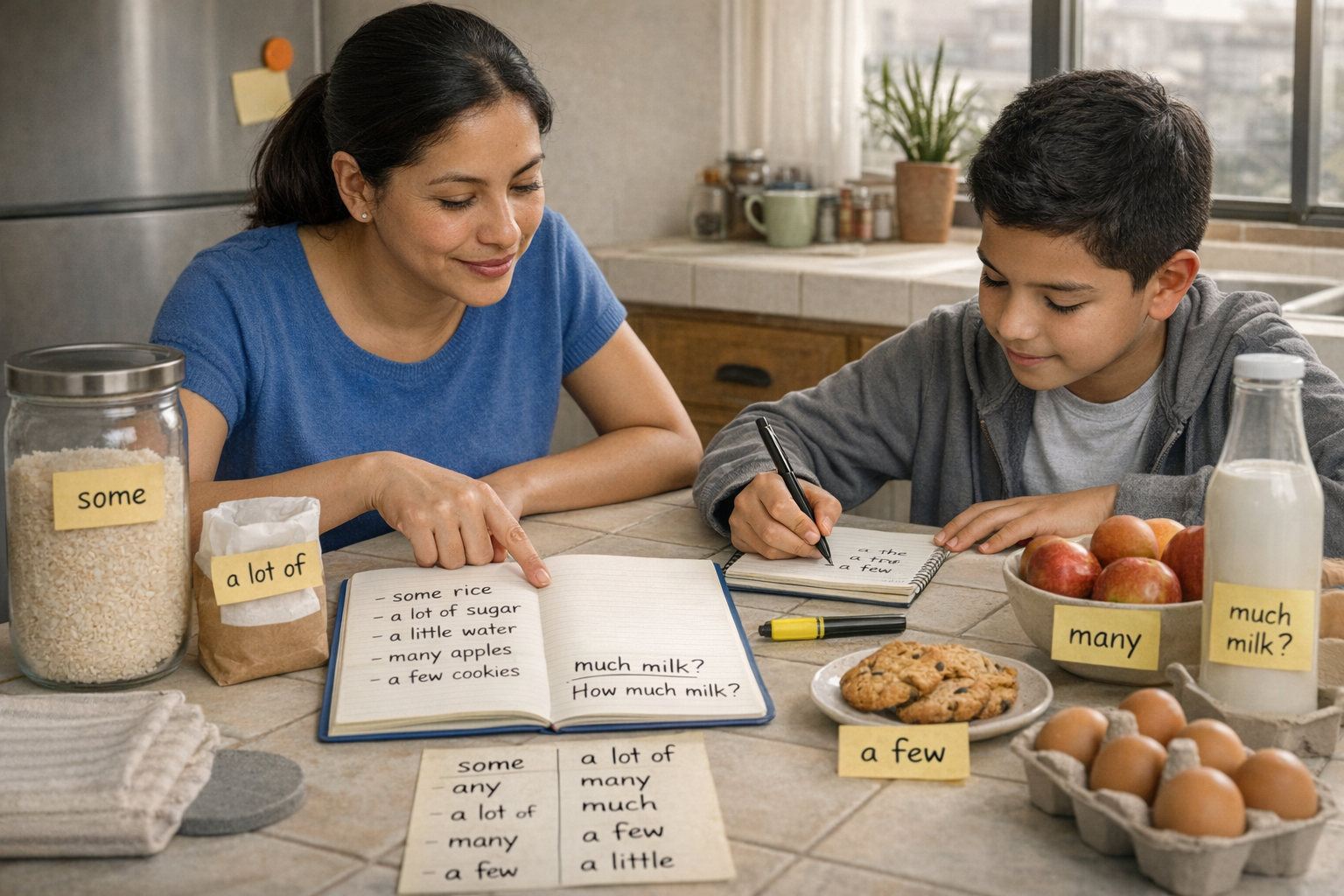
Los cuantificadores en inglés son palabras clave que te permiten hablar de cantidad, tanto en afirmaciones como en preguntas o negaciones. Usamos some, any, a lot of, much, many, a few, a little, entre otros, para expresar lo que tenemos, lo que queremos o lo que falta. Aprenderlos correctamente desde el inicio es esencial para desenvolverse con fluidez.
En esta lección verás ejemplos reales que muestran cómo y cuándo usar cada cuantificador. Las frases están basadas en situaciones diarias como pedir comida, contar objetos, hablar de dinero o tiempo libre. Este enfoque práctico mejora tu vocabulario y tu comprensión gramatical al mismo tiempo.
Gramática clave
Some: se usa en afirmaciones con contables e incontables.
I need some help. / I have some water.
I need some help. / I have some water.
Any: aparece en preguntas y negaciones.
Do you have any coffee? / There isn’t any bread.
Do you have any coffee? / There isn’t any bread.
A lot of: se usa para grandes cantidades.
There are a lot of people. / I have a lot of work.
There are a lot of people. / I have a lot of work.
Much / Many:
Much para sustantivos no contables: Do you have much money?
Many para sustantivos contables: Do you have many friends?
Much para sustantivos no contables: Do you have much money?
Many para sustantivos contables: Do you have many friends?
A few / A little:
A few con contables: I have a few questions.
A little con no contables: I have a little time.
A few con contables: I have a few questions.
A little con no contables: I have a little time.
No: indica ausencia total.
There is no bread. / There are no students.
There is no bread. / There are no students.
How much / How many: para hacer preguntas sobre cantidad.
How many books? / How much sugar?
How many books? / How much sugar?
Practicar estos cuantificadores te permite hablar con más precisión y naturalidad en inglés. Además, mejora tu capacidad para responder en conversaciones reales sin traducir mentalmente desde el español.
¿Cómo reforzarlo?
Nuestro libro para principiantes incluye ejercicios guiados con estos cuantificadores, listas de sustantivos contables e incontables, y actividades con audios para escuchar cómo se usan en contexto. Es ideal para dominar esta parte esencial de la gramática básica.
Habla con claridad. Aprende a expresar lo que tienes, lo que quieres y lo que necesitas… en inglés.
Practica con la IA estas frases
Some – Water
A: Do you have some water?
B: Yes, I have some water in the fridge.
A: Do you have some water?
B: Yes, I have some water in the fridge.
Some – Help
A: I need some help with my homework.
B: Okay, I can give you some help.
A: I need some help with my homework.
B: Okay, I can give you some help.
Any – Family (pregunta)
A: Do you have any brothers or sisters?
B: No, I don’t have any brothers or sisters.
A: Do you have any brothers or sisters?
B: No, I don’t have any brothers or sisters.
Any – Coffee (negativa)
A: Do we have any coffee?
B: No, we don’t have any coffee.
A: Do we have any coffee?
B: No, we don’t have any coffee.
A Lot Of – Work
A: I have a lot of work today.
B: Really? I don’t have a lot of work.
A: I have a lot of work today.
B: Really? I don’t have a lot of work.
A Lot Of – People
A: There are a lot of people in the park.
B: Yes, there are a lot of children too.
A: There are a lot of people in the park.
B: Yes, there are a lot of children too.
Many – Friends
A: Do you have many friends?
B: Yes, I have many friends at school.
A: Do you have many friends?
B: Yes, I have many friends at school.
Many – Chairs
A: Are there many chairs in the room?
B: No, there aren’t many chairs.
A: Are there many chairs in the room?
B: No, there aren’t many chairs.
Much – Money
A: Do you have much money?
B: No, I don’t have much money.
A: Do you have much money?
B: No, I don’t have much money.
Much – Sugar
A: Is there much sugar in the coffee?
B: No, there isn’t much sugar.
A: Is there much sugar in the coffee?
B: No, there isn’t much sugar.
A Few – Questions
A: I have a few questions.
B: Okay, you can ask a few questions.
A: I have a few questions.
B: Okay, you can ask a few questions.
A Few – Apples
A: There are a few apples in the kitchen.
B: Great, I want a few apples.
A: There are a few apples in the kitchen.
B: Great, I want a few apples.
A Little – Time
A: I have a little time now.
B: Good, we can study a little English.
A: I have a little time now.
B: Good, we can study a little English.
A Little – Milk
A: Is there a little milk in the fridge?
B: Yes, there is a little milk.
A: Is there a little milk in the fridge?
B: Yes, there is a little milk.
No – Bread
A: Is there any bread?
B: No, there is no bread.
A: Is there any bread?
B: No, there is no bread.
No – Students
A: Are there any students in the class?
B: No, there are no students now.
A: Are there any students in the class?
B: No, there are no students now.
How Many – Brothers
A: How many brothers do you have?
B: I have two brothers.
A: How many brothers do you have?
B: I have two brothers.
How Many – Books
A: How many books are on the table?
B: There are five books.
A: How many books are on the table?
B: There are five books.
How Much – Water
A: How much water do you drink every day?
B: I drink a lot of water every day.
A: How much water do you drink every day?
B: I drink a lot of water every day.
How Much – Sugar
A: How much sugar do you want in your coffee?
B: Just a little sugar, please.
A: How much sugar do you want in your coffee?
B: Just a little sugar, please.